There's a scene that repeats in almost every training. A simple pass. An error. Silence. And suddenly, the body is still on the field, but the head is somewhere else: in the mistake, in the judgment, in that internal dialogue that weighs more than any defender.

There's a scene that repeats in almost every training. A simple pass. An error. Silence. And suddenly, the body is still on the field, but the head is somewhere else: in the mistake, in the judgment, in that internal dialogue that weighs more than any defender.
In Ultimate Frisbee —and at Disckatus we know this well— the hardest game isn't played against the team across from you, but against yourself. That's where sports emotional intelligence comes in: that invisible skill that isn't trained with cones or a stopwatch, but that decides points, games… and personal trajectories.
Because ultimate isn't just running and throwing. It's feeling, interpreting, and deciding. All at the same time.
Inside every player live two voices. One is loud, demanding, impatient. It's Self 1: the ego that judges, compares, and commands. The other is quiet and effective. It's Self 2: the one that throws, cuts, reacts.
When you miss an easy pass and hear "How could I do that?", it's not your body talking. It's Self 1 interfering. And the more it yells, the more your body tenses, the more rigid your decision-making becomes.
Sports psychology is clear: performance appears when Self 2 acts without being constantly interrupted by judgment. It's not about "thinking positive", it's about reducing internal noise. At Disckatus we're not looking for perfect players, we're looking for present players.
Interesting paradox: the less you control yourself, the better you play.
In competition, 90% of performance depends on emotional management. Not because emotions are good or bad, but because they're fast. Automatic. Immediate.
The process usually goes like this:
It all happens in less than a second.
The common mistake is trying to eliminate the emotion. But that's like trying to stop the wind with your hands. The key isn't to fight what you feel, but to change your relationship with it.
That's where psychological flexibility comes in: accepting that the thought is there without obeying it. Doubt can appear… and you still keep cutting. Fear can arise… and you still throw.
That's also Spirit of the Game, even if it's not always said.
Defusion is a simple and powerful tool: it means seeing thoughts as words, not as absolute truths.
"I'm not good enough" isn't a fact. It's a phrase that appears. Like a cloud. Like background noise.
When a player learns to observe that thought without fusing with it, something almost magical happens: the body relaxes, attention returns to the disc, the game continues.
At Disckatus we train this without excessive formality. You notice when someone misses, breathes… and keeps asking for the disc. That's emotional intelligence in action.
Not all training happens on the field. One of the most powerful—and least spectacular—tools is the sports emotional diary.
After each training or game:
Over time, this creates a personal map. A mental playbook. You start recognizing patterns: when you speed up, when you disconnect, when you flow.
Revealing paradox: the more you know yourself, the less you block yourself.
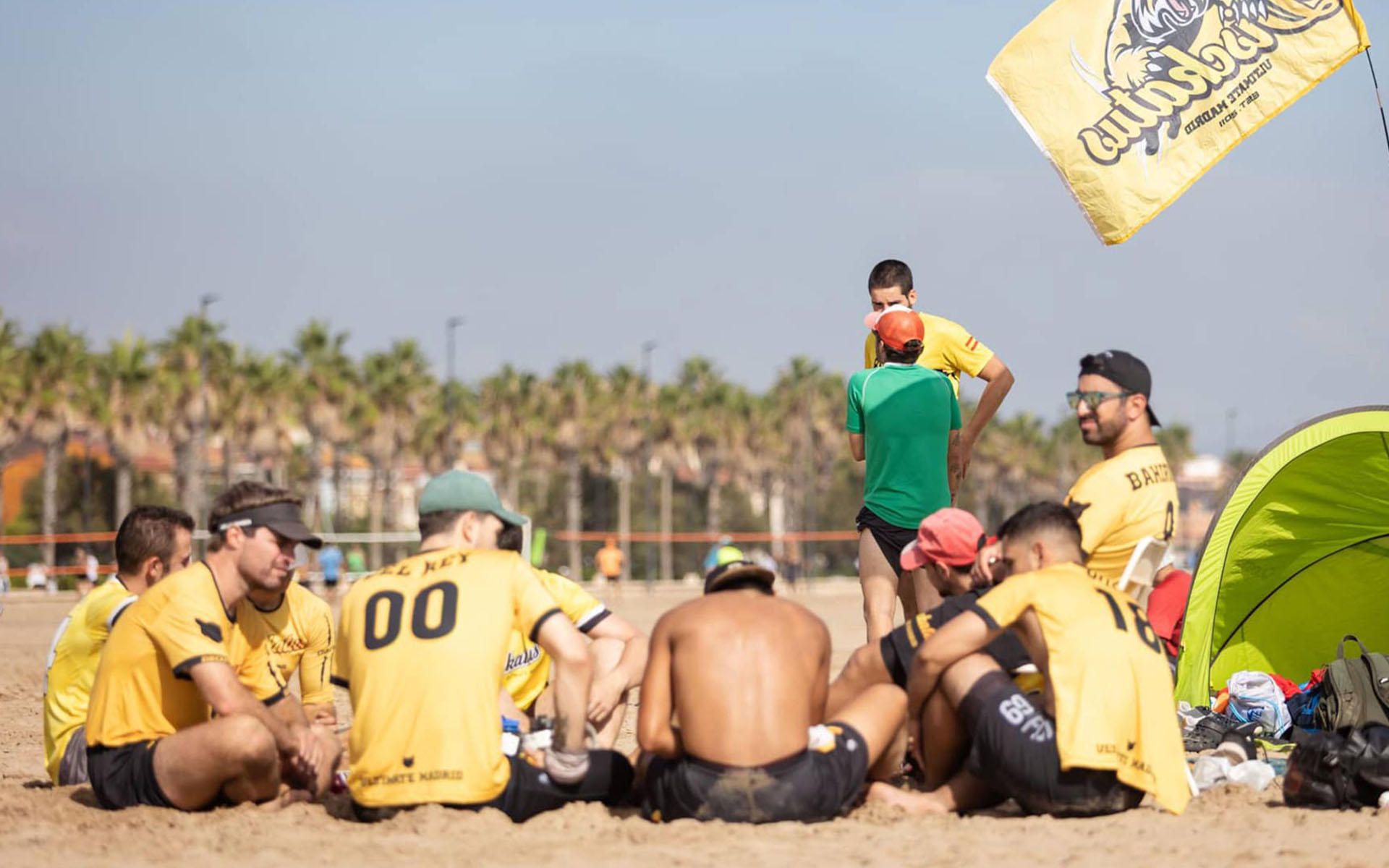
At Disckatus we don't understand psychology as something individual. Emotion is contagious. So is calm. A team with a strong identity suffers less stress, recovers faster, and decides better under pressure.
When someone fails and the team responds with support, it's not just good vibes: it's shared emotional regulation. It's applied neurobiology without the white coat.
That's why we care about language, silences, and looks here. Because the inner game is also collective.
Emotional intelligence in Ultimate is like the flight of the disc.
Without that mental air, the disc falls fast. With it, it even corrects its course when there's wind.
At Disckatus we train to throw hard, yes. But above all we train to fly together.
📚 Sources and Inspiration: This article has been developed by integrating fundamental concepts from sports psychology and high performance adapted to the practice of Ultimate Frisbee. The ideas about the mental battle and the concept of "Self 1 and Self 2" are based on Timothy Gallwey's pioneering work, specifically in his book The Inner Game of Tennis. Likewise, the emotional management exercises and the definition of Sports Intelligence draw from the teachings of Miguel A. Rodríguez (specialist in Mindfulness and NLP) and Daniel Goleman's theories on emotional intelligence. Finally, the specific strategies for Ultimate teams on shared leadership, group identity, resilience, and mental flexibility are grounded in the research and technical articles by Tom Banister-Fletcher and Sara Svoboda for the international Ultimate community. Technical bibliography consulted: Gallwey, W. T. (1974). The Inner Game of Tennis. Editorial Sirio. Rodríguez, M. A. Guide to Emotional Intelligence for Athletes. InteligenciaDeportiva.es. Banister-Fletcher, T. Sports Psychology: Fostering your team's identity & Shared leadership in team sports. Svoboda, S. Getting out of your head and into the game: Navigating the challenges of Ultimate with a flexible mind. Goleman, D. (1995). Emotional Intelligence.


