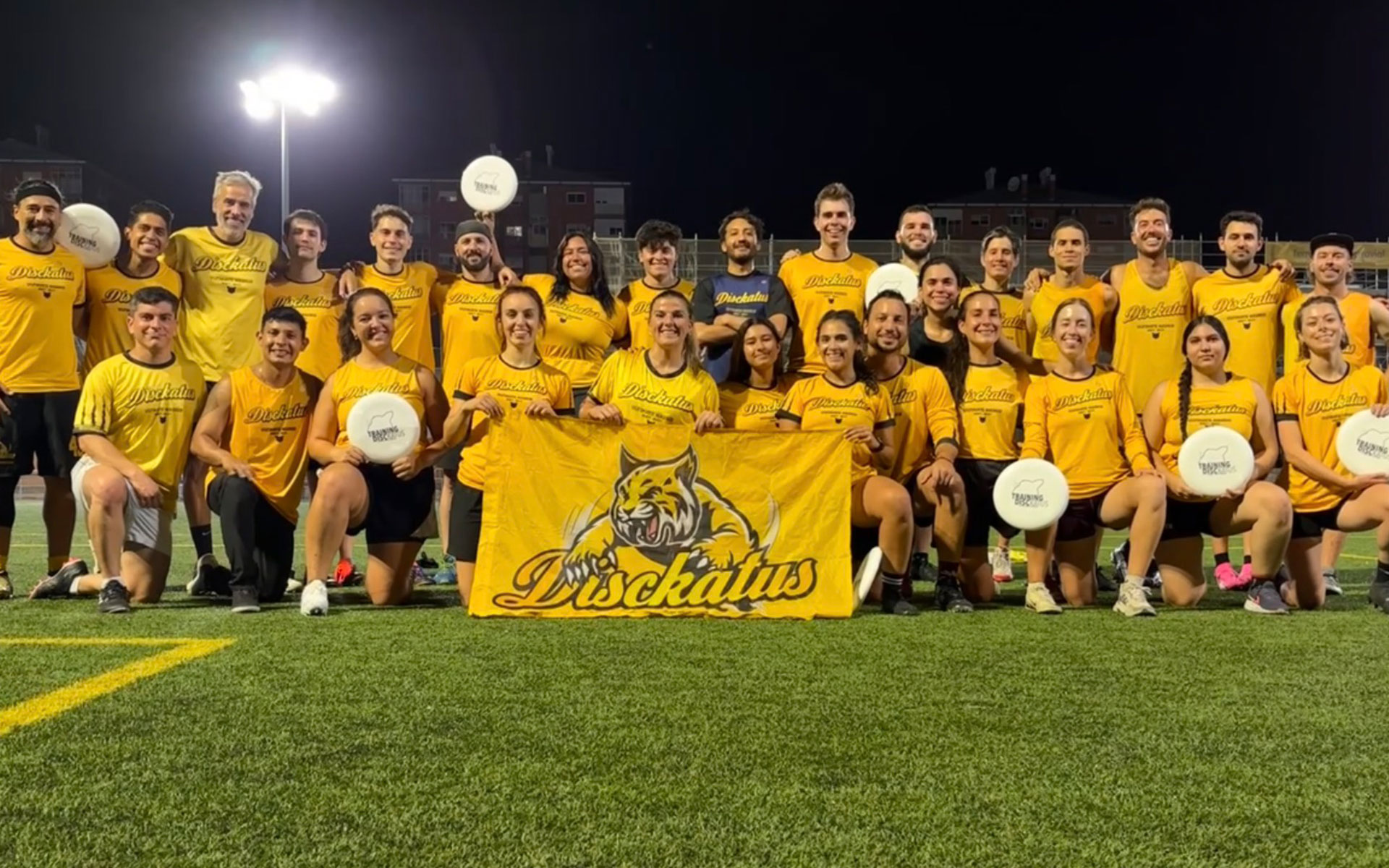
When we let go of perfection, confidence appears.

There's a fear that almost no one admits out loud, but that appears silently just before picking up the disc: "I can't fail now".
At Disckatus we know it well. Not because we're an insecure team, but precisely because we care. Because we want to contribute. Because we feel we owe something to the group.
The irony—cruel, but pedagogical—is that this very care can become the biggest obstacle. When responsibility transforms into pressure, the game shrinks. The body tenses. The mind runs faster than the disc.
Coach Antoine Davis expresses it with uncomfortable clarity: many players play "tight" because they believe they owe their team a perfect game. And that thought, although born from commitment, ends up sabotaging it.
This article isn't about demanding more. It's about letting go better.
Sports perfectionism isn't healthy ambition. It's something else.
It's that constant internal dialogue that leaves no room for the present. It's playing while looking at the past ("I already failed") or the future ("what if I fail?"), but never the now.
In ultimate, where decisions are quick and mistakes are part of the game's flow, this mentality is especially damaging. The player starts protecting instead of attacking. Avoids the open pass. Doesn't cut with conviction. Hesitates where they used to react.
Pure antithesis: the more you try not to fail, the more likely you are to fail.
Not because you're a worse player, but because you're no longer playing. You're thinking about playing.
There's a huge difference—though subtle—between playing worried and playing present.
At Disckatus we don't need tense heroes. We need available people.
Davis's proposal is so simple it's hard to believe it works:
👉 You don't owe your team perfection. You owe presence, effort, and a clear role.
That's all. And it's not little.
From a sports psychology perspective, this shift is enormous. Moving from "I have to do everything right" to "I'm going to do this right, now" reduces anxiety, focuses attention, and frees mental resources.
Before each point, the question isn't:
"What if I fail?"
But rather:
"What's my role in this point?"
Defend hard. Open space. Be a safe option. Cut deep even if the pass doesn't come.
Nothing epic. Everything essential.
Like the pieces of a gear: small separately, unstoppable together.
A team doesn't break from mistakes. It breaks from shared fear.
And conversely, it strengthens when someone dares to play without fear.
When a player focuses on their role:
At Disckatus, when someone fails and calls for the disc again, they're sending a message more powerful than any speech: "I'm here. We continue."
That creates psychological safety. And without it, no tactical system holds up.
Understanding it isn't enough. We have to practice it. Little by little. Together.
Normalize it. Say it. Share it.
Before an important point, someone says: "my role is to mark hard" or "my role is to bring calm".
A risky pass well-read even if it doesn't connect.
A decisive cut even if they don't see you.
That's also playing well.
After a game, don't just ask what to improve, but:
Sometimes the answer is yes, even if the point was lost. And that counts too.
Disckatus doesn't need infallible players.
It needs committed people who allow themselves to fail without disappearing.
When we release the impossible demand for perfection, something better appears: confidence.
And when confidence becomes collective, the team stops playing with fear… and starts playing with
purpose.
Ultimate, in the end, isn't about not making mistakes.
It's about continuing to choose to be there.
And that, point by point, is what makes us a team.
LEARNING ROUTE
Each chapter connects to the next skill, so you can move from first throws to confident play.